Creating a company
Every sustainable company is built on a solid foundation. While many entrepreneurs focus on products, services, or technology, the true engine of growth lies in understanding and reinforcing the core fundamentals of a viable business model.
Core foundations of a viable company
A business cannot exist in the long term without three indispensable elements: a clear value proposition, the ability to sell effectively to our clients and having an ongoing economic sustainability.
The value proposition is more than just a description of what you offer, it's a commitment to solve a specific problem or fulfill a need for your customer. Without this clarity, even the best products risk becoming irrelevant. There are many projects that for us might seem to have a lot of potential, but actually be a chindogu (from the japanese chin (useless) and dogu (tool)).
Being able to sell means turning that value into action. It’s not just about having a sales process, it’s about generating consistent revenue and building a customer base that recognizes your offer as worth paying for.
And then comes economic sustainability. If the business doesn't make a profit over time, enough to sustain operations, invest in growth, and recover from setbacks, it cannot thrive. These three pillars are non-negotiable for any entrepreneur hoping to build a long-lasting business.
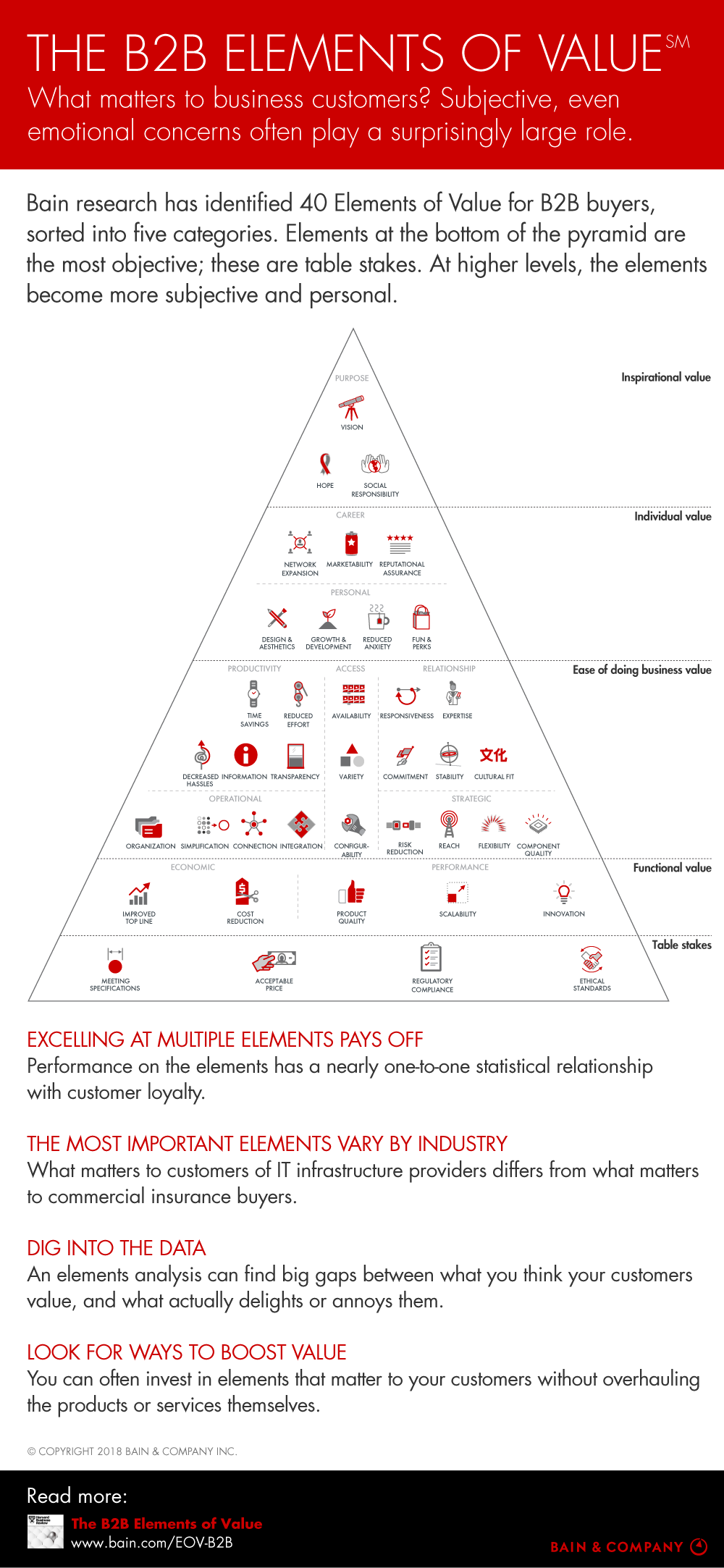
Company elements of value
Bain company made a Maslow pyramid with the different elements of value that a company might provide.
B2B

B2C

From viability to scalable growth
Once the basic structure is in place, the next challenge is to grow. But growth is not about doing more of the same. It's about doing things better, smarter, and in ways that distinguish your business from competitors.
A company positioned for growth offers a differentiated and credible value proposition, something the market sees as unique and valuable. It has also developed a capacity to outperform the competition in how it sells, not just in what it sells. These organizations don’t just survive; they thrive by generating real economic benefit and by fostering effective, inspirational leadership that aligns people with purpose.
Innovation vs Entrepreneurship
Innovation is about creating something new or significantly improving what already exists. This could be a product, a process, a service, or even a way of thinking. Innovation often involves creativity and problem-solving, aiming to do things better, faster, or in a completely different way. For instance, developing a new type of biodegradable packaging or designing a more efficient workflow system would count as innovation. You don't need to start a business to innovate, you can innovate within a company, a government organization, or even as an artist or researcher.
Entrepreneurship, on the other hand, is about starting and building something, typically a business. It involves taking initiative, assuming risk, and organizing resources to bring an idea to life in the market. Entrepreneurs focus on execution: turning ideas (sometimes innovative, sometimes not) into functioning ventures. For example, opening a local bakery is an act of entrepreneurship, even if it doesn’t introduce anything new to the market. But launching a tech startup with a groundbreaking product would be both entrepreneurial and innovative.
Rethinking strategy through reflection
It's not enough to run the business, we must understand what truly makes it work.
This means asking difficult but essential questions:
Do I really know what differentiates my company? What is it that we do that no one else can easily replicate? Am I in touch with the current and future needs of my market? Do I truly understand my client’s world, their goals, frustrations, and expectations? And most critically, do I have a clear, well-defined business model that supports all of the above?
These are not abstract questions. The answers form the foundation of sound strategic decision-making. We have to focus in the problem of the client, not trying to make our idea fit on it.
Innovation as a strategic imperative
In today’s world, change is constant. Global shifts, technological evolution, and cultural trends force companies to adapt rapidly. While we cannot change the environment, we can choose how we respond to it.
Innovation, then, becomes a survival skill, not only in products or services, but in how we design and operate the entire business model. This includes how we create value, how we deliver it, and how we monetize it. True innovation often comes from doing familiar things in unfamiliar ways, or by rethinking the assumptions that underpin our strategy.
Understanding business models and core competencies
One of the most impactful exercises any business leader can do is to revisit their business model to question how the company creates, delivers, and captures value.
A powerful business model is anchored in a set of core competencies, those unique capabilities that the company does exceptionally well. But not every strength qualifies. To be truly strategic, a core competency must be valuable to the customer, sustainable over time, difficult to imitate, and clearly different from what competitors offer.
Many organizations benefit from frameworks like the Business Model Canvas, which helps visualize and assess each component of the business in a structured way. It provides clarity and uncovers opportunities for optimization and innovation.

Putting the customer at the center
In business, everything starts and ends with the customer. The client’s perspective, not the company’s, is what should guide strategy.
This means deeply understanding what the customer values, what fears they face, what problems they need solved, and what drives their loyalty. It's crucial to ask: What needs am I currently meeting? Which ones could I meet in the future? Do I understand how my client's business works, and how I can contribute to their success?
Knowing the answer to these questions allows a company to not only improve its offering but to build real, long-term relationships. In B2B environments, especially, understanding barriers to switching providers and factors that drive trust are essential for retaining customers.
Drivers of growth and differentiation
Growth rarely happens by accident. It’s driven by a clear strategy and deliberate action. There are many levers companies can pull to accelerate progress: strengthening the business model, embracing strategic innovation, cultivating an entrepreneurial culture, securing funding, expanding geographically, segmenting customers more effectively, increasing market penetration, or opening new sales channels.
However, recognizing these levers is not enough. Entrepreneurs must also be willing to confront the barriers that hold them back internally.
Internal barriers and the leadership challenge
Many of the most significant obstacles to business growth are not external, they are internal and personal. Leaders often encounter thoughts like "I don’t know how," "I can’t," or "I don’t want to." These are often symptoms of fear, resistance to change, or lack of clarity.
Time constraints, unclear delegation, fear of failure, and structural inertia can all slow progress. The key is for leaders to take ownership: to ask themselves what they are doing that no longer serves them, what must change in their organization, and whether they are truly willing to lead that change.
Ultimately, leadership is about more than making decisions. It’s about setting strategic direction, maintaining focus, applying methods with consistency, and being disciplined in execution. Without this commitment, even the best strategies will fail to take root.
Manage emotions properly
Many internal dilemmas will arise during the definition and creation of your own company. Make sure to know how to handle them: managing emotions